A Soul Thread
The Marks of a Christ-Formed Leader
The 5Cs of Adaptive Christian Leadership
Five emerging qualities of a leader God loves and is still forming.
Leadership brings us into situations we cannot fully control.
A decision must be made. Someone needs care. An expectation becomes heavier than we anticipated. The work changes, and familiar answers no longer seem sufficient.
These moments ask something of our judgment and skills. They also reveal what is happening in us.
What do we reach for when we feel threatened? How do we respond when someone disagrees? What happens when our limits become visible, or our contribution goes unnoticed?
God meets us in this real ground of leadership.
Before we examine what needs to grow, we begin here: in Christ, we are loved. We can bring our unfinished lives into His presence without pretending to be further along.
The five Cs offer language for noticing how Christ’s life may be taking shape in us and through us. They belong together. We return to them across different seasons, with different needs and responsibilities.
Christ at the Heart of Our Formation
Christian leadership begins in relationship with Christ. We learn from Him, depend on Him, receive His love and follow Him into the responsibilities already before us.
Christ-Centered Character sits at the heart of the five Cs because the person we are becoming shapes how we discern, act, carry responsibility and care for others.
Character grows through life with Jesus: receiving grace, practising obedience, accepting correction, repairing harm and returning to Him when we fall short.
The other four Cs give expression to that formation in the changing realities of leadership.
Together, they invite us to see with God, follow Jesus, carry faithfully and love others as people who are becoming more like Christ.
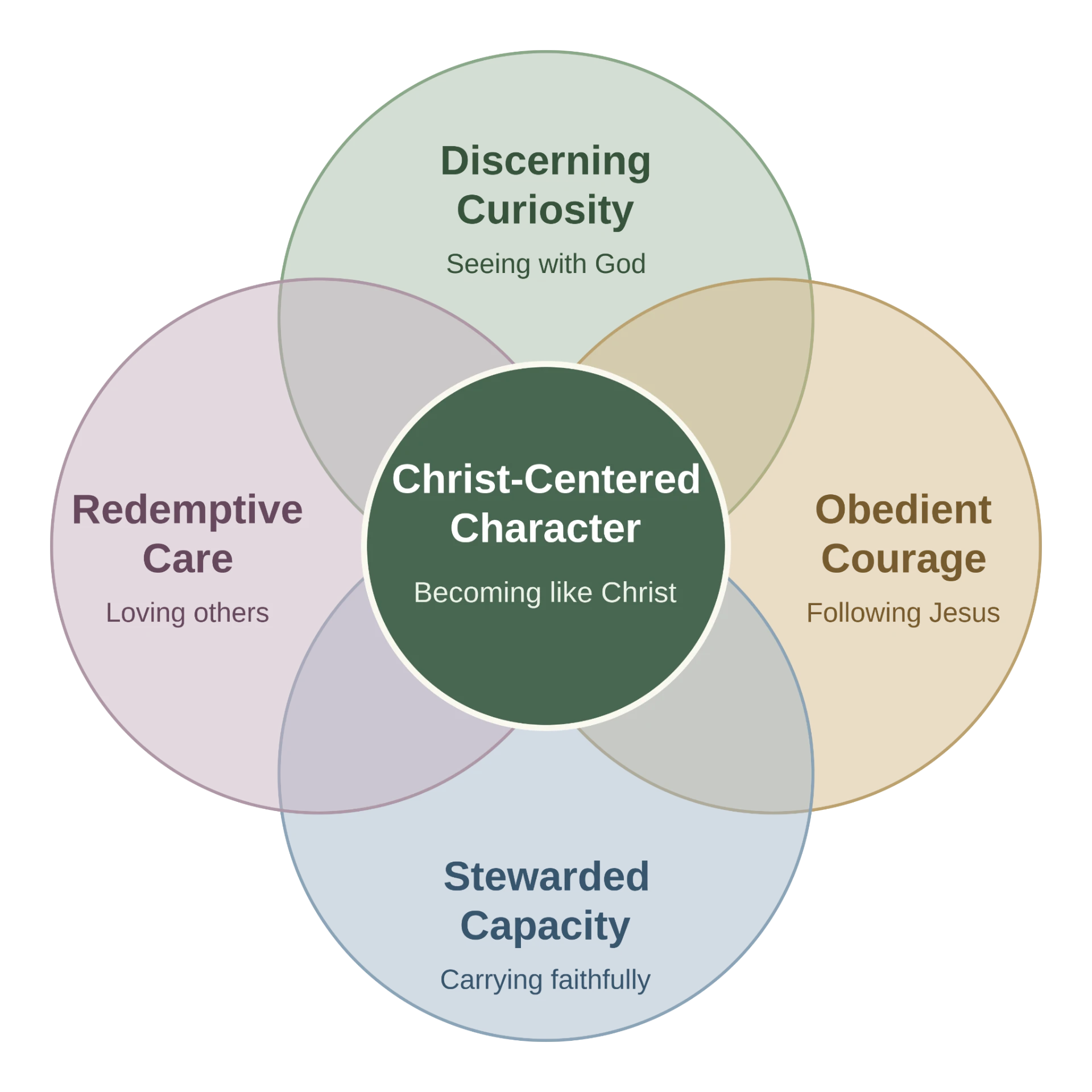
- Christ-Centered Character — Becoming like Christ
- Discerning Curiosity — Seeing with God
- Obedient Courage — Following Jesus
- Stewarded Capacity — Carrying faithfully
- Redemptive Care — Loving others
1. Christ-Centered Character
Becoming like Christ
Our character becomes visible in ordinary responses: how we use authority, receive criticism, speak about someone who is absent, acknowledge a mistake or treat a person who cannot advance our interests.
Following Jesus gradually reshapes these responses. We learn to tell the truth without using it to wound, to exercise strength with gentleness, and to take responsibility without defending every part of ourselves.
We can acknowledge what needs to change because our belonging to Christ is already held.
Behold Jesus
Read John 15:4–5 and Philippians 2:1–8.
Jesus invites His disciples to remain in Him. Paul directs our attention to Christ’s humility and self-giving love. Our formation is nourished by that relationship and expressed in the way we live with others.
Emerging qualities
- Integrity between public words and private actions.
- Humility that can receive correction.
- Honesty about failure and willingness to repair harm.
- Gentleness, patience and growing freedom from the need to impress.
When formation becomes difficult
Pressure can expose defensiveness, secrecy or a strong need to be right. Bring what you notice to Christ. Receive forgiveness where it is needed, and consider what a truthful response would require.
2. Discerning Curiosity
Seeing with God
Leadership often rewards quick answers. Discerning curiosity creates room to understand before deciding.
We attend to Scripture, the situation, our own reactions and the people affected. We ask what we may have missed. We listen for losses, hopes and concerns beneath another person’s position, while recognising that we cannot assume we know their heart.
Prayerful attention helps us test our interpretation and remain open to correction. It can also reveal when enough is known to take a step.
Behold Jesus
Read Mark 10:46–52 and James 1:19–20.
Jesus stops and asks Bartimaeus what he wants Him to do. James calls us to listen readily and respond slowly. These passages invite attention that makes room for another person’s voice.
Emerging qualities
- Listening before defending or solving.
- Asking questions that help others speak honestly.
- Distinguishing observations from assumptions.
- Testing impressions through Scripture, counsel and the realities before us.
When formation becomes difficult
Fear can make us certain too quickly. Curiosity can also become a way of postponing an uncomfortable decision. Notice whether your questions are helping you see more clearly and respond more faithfully.
3. Obedient Courage
Following Jesus
Courage takes different forms. Sometimes we need to speak. Sometimes we need to apologise, ask for help, uphold a boundary or take an uncertain step.
Obedient courage grows as we attend to Christ and respond to what we have discerned. We bring our fear with us, seek wise support and act with care for those affected.
Faithfulness may cost approval. It may also require changing our mind when new truth becomes clear.
Behold Jesus
Read Mark 14:32–36 and Acts 5:27–32.
In Gethsemane, Jesus brings His anguish to the Father and yields to Him. In Acts, the apostles continue to bear witness under pressure. Courage can include honest fear and costly obedience.
Emerging qualities
- Willingness to act on a tested conviction.
- Truthfulness when silence would protect only our comfort.
- Humility to acknowledge uncertainty and seek counsel.
- Perseverance without contempt for those who disagree.
When formation becomes difficult
Urgency, anger and the desire to prove ourselves can feel like courage. Fear can also disguise itself as endless preparation. Ask what love, truth and your actual responsibilities require now.
4. Stewarded Capacity
Carrying faithfully
Capacity includes our abilities, time, energy, relationships and resources. It also includes our limits and the season of life we are in.
Stewarding capacity means developing what can grow, sharing responsibility wisely, and acknowledging what we cannot sustainably carry.
Sometimes faithfulness asks us to stretch. Sometimes it asks us to rest, delegate, simplify or decline. We discern this with God and with people who can help us see our responsibilities clearly.
Behold Jesus
Read Mark 6:30–32 and Exodus 18:17–23.
Jesus invites the apostles to come away and rest. Jethro helps Moses recognise the cost of carrying the people’s needs alone. Limits can become a place for receiving help and making wiser arrangements.
Emerging qualities
- Realistic commitments and clear expectations.
- Willingness to learn and develop appropriate skills.
- Shared responsibility, delegation and accountability.
- Rhythms of rest and honest attention to health and relationships.
When formation becomes difficult
Being needed can become part of our identity. We may keep accepting more while neglecting what has already been entrusted to us. We may also retreat from a responsibility that requires growth. Bring both possibilities into honest discernment.
5. Redemptive Care
Loving others
People experience our leadership through the attention we give, the decisions we make and the way we respond when something goes wrong.
Redemptive care seeks their good with truth, compassion and respect for their dignity. It makes room for encouragement, accountability, boundaries and repair.
We participate in Christ’s care for people while recognising their agency and our limits. We can offer support without taking ownership of another person’s choices or growth.
Behold Jesus
Read Mark 10:17–22 and John 13:1–17.
Jesus looks at the rich man with love and speaks a difficult invitation. He washes His disciples’ feet. His care helps us hold tenderness, truth and practical service together.
Emerging qualities
- Attention to people whose needs or voices are easily overlooked.
- Encouragement that sees more than someone’s output.
- Honest conversations that preserve dignity.
- Willingness to acknowledge harm, seek repair and support appropriate accountability.
When formation becomes difficult
Care can become rescuing, avoiding disagreement or needing to be needed. Frustration can also make us reduce a person to the problem they bring. Ask Christ to help you see the person clearly and respond within your responsibility.
Where the Five Cs Meet
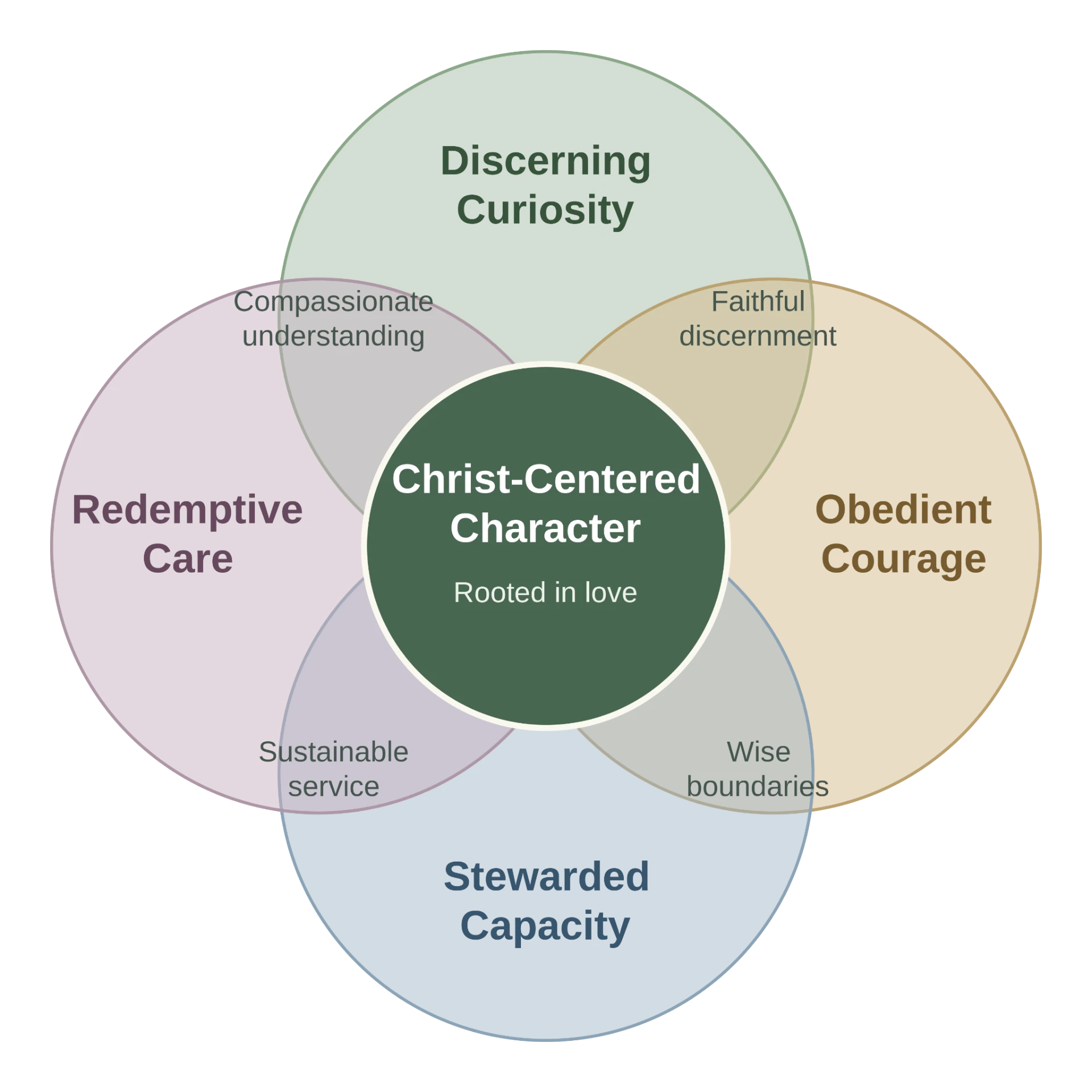
The five Cs reinforce one another. These intersections illustrate how that can look in practice; they are examples rather than additional competencies.
- Discerning Curiosity and Obedient Courage: Faithful discernment—listening carefully and acting on what has been prayerfully tested.
- Obedient Courage and Stewarded Capacity: Wise boundaries—having the courage to name what can be carried responsibly.
- Stewarded Capacity and Redemptive Care: Sustainable service—caring for people through shared responsibility and realistic commitments.
- Redemptive Care and Discerning Curiosity: Compassionate understanding—listening closely enough to see the person beyond the immediate problem.
Christ-Centered Character remains at the heart. We keep returning to Jesus as these qualities grow together.
One Situation, One Invitation
You do not need to examine every part of your leadership today.
Bring one real situation to God: a conversation, decision, responsibility or relationship that is asking for your attention.
Prayer
Lord Jesus,
Thank You that I am loved while I am still being formed.
Help me remain close to You in the responsibilities before me. Shape my character, open my attention, strengthen my courage, and teach me to carry what is mine with wisdom.
Let the people affected by my leadership encounter greater truth, dignity and care.
Where I fall short, help me receive Your grace, acknowledge what needs to change and take the next faithful step.
I entrust the growth and the fruit to You.
Amen.
You are loved, and still being formed.
More to sit with
Integrated Christian Leadership
Explore identity, alignment, care and mission held together in Christ.
The Adaptive Formation Rhythm
Bring one real situation into noticing, receiving, walking and entrusting.
Christian Leadership Reflection Guide
Reflect more broadly on the life beneath your leadership.
Faithful Execution
Give faithful intentions appropriate structure, clarity and accountability.
Pass it on
Formation isn’t meant to be walked alone.
Is there another leader in your life who is carrying a heavy load right now? You can leave a quiet door open for them — no pressure, no reply needed.
If now feels rushed, that's okay. Formation rarely happens in a hurry — sit with God later and return when you can be fully present.
Want to talk this over with someone?
A first conversation with the Adaptivity Monk. No cost, no pressure.
Talk it over