Part 2 of 6
When Conflict Reveals Something Deeper
The survival triangle and the way of restoration
Opening reflection
Anger is often not the first emotion. Sometimes beneath frustration is fear. Exhaustion. Feeling unseen. Loss of control. Disappointment. Shame.
Conflict can reveal more than what is happening between people. It can reveal what is happening within us.
When pressure rises, relationships often become reactive. Fear increases. Trust decreases. People protect themselves. Slowly a relational triangle begins to form — someone becomes the problem, someone becomes the rescuer, someone becomes misunderstood, blamed, withdrawn, or controlling.
But the way of Jesus invites something different. Not denial. Not passivity. Not pretending conflict does not exist — but restoration, truth, humility, curiosity, compassion, discernment.
Scripture
"If it is possible, as far as it depends on you, live at peace with everyone." (Romans 12:18)
Romans 12:18
A guided practice
Mapping the drama before God
Bring to mind one current workplace tension, relational conflict, misunderstanding, or leadership burden.
Name the situation. What is happening? What feels emotionally charged? What feels unresolved?
Name the stakeholders. For each person, reflect gently: what pressures may they be carrying? What fears may exist beneath their behavior? What good desire may be underneath unhealthy reactions? How may God have uniquely designed or gifted them?
Notice the survival triangle. Where do you see blame, rescuing, defensiveness, withdrawal, control, gossip, avoidance, or emotional alliances? Which role do you most naturally drift toward?
Jesus is also in the triangle — not as another stakeholder, but as the One who sees each person without distortion. He is not above the room; He is in it.
Invite Him in. What might He notice? What might grieve Him? What compassion might He hold for each person? What truth might He speak gently? What would love require now?
Pray slowly for each person by name — asking God for wisdom, humility, protection from offense, courage, reconciliation, healthy boundaries, discernment, and peace.
A pastoral note: tenderness is not passivity. Restoration does not mean tolerating harm. Wisdom, honesty, courage, and healthy boundaries belong inside this prayer too — and sometimes the most loving step is the harder, truer one.
A visual to sit with
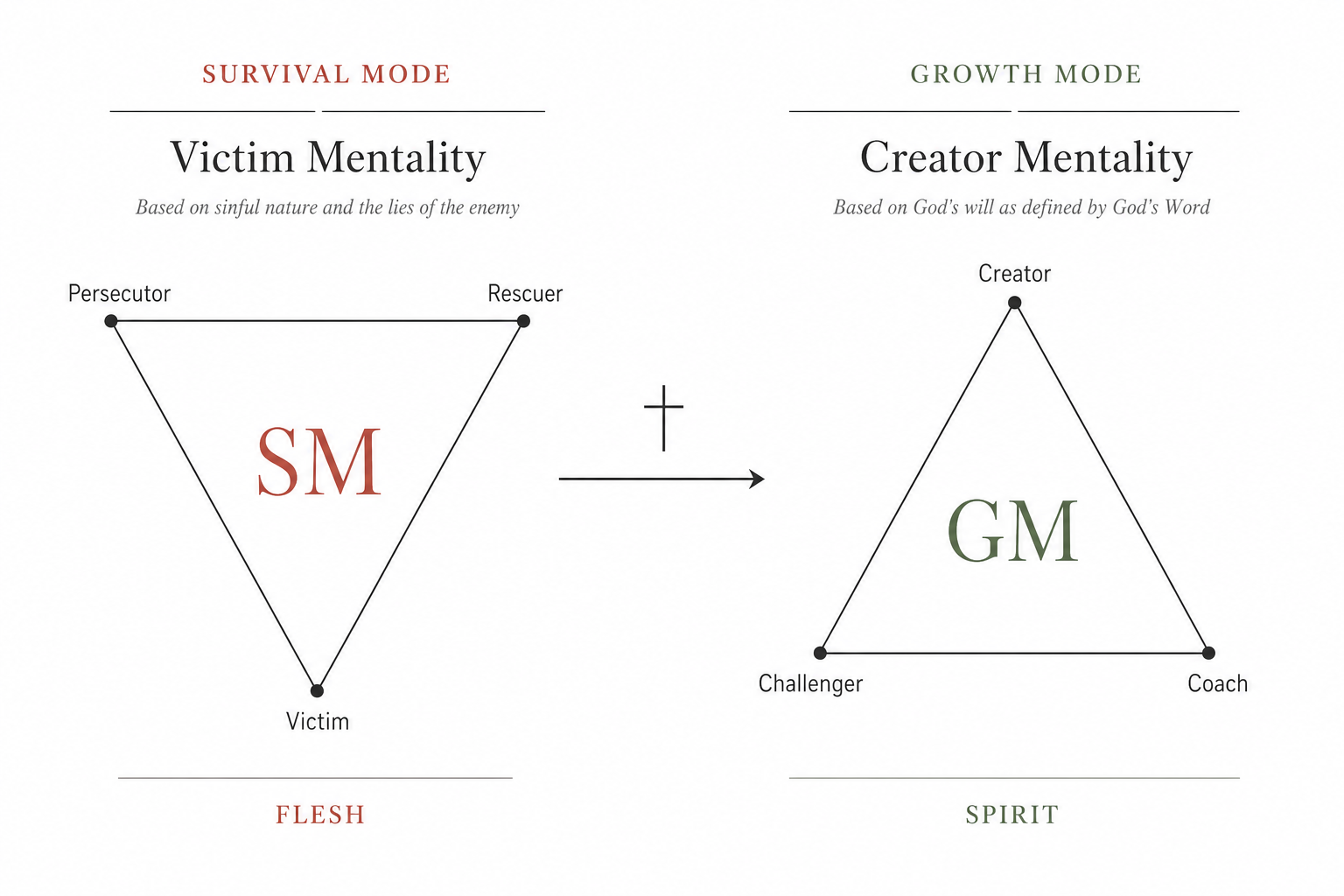
From the survival triangle toward the growth triangle
The Survival triangle — Persecutor, Rescuer, Victim — is what relationships drift into when fear, self-protection, and old wounds run the room. The Growth triangle — Challenger, Coach, Creator — is what the Spirit slowly forms in us when love, truth, and dependence on God run the room instead.
Each stakeholder, including you, may drift between roles depending on who they are with and what is at stake. Someone may be a Rescuer with one person and a Persecutor with another, a Victim in the morning and a Creator by afternoon. The map is rarely fixed.
The shift from one triangle to the other does not begin with strategy. It begins quietly, when one person — sometimes you — surrenders a survival role to the Spirit and lets it be re-formed into its growth counterpart: Victim into Creator, Rescuer into Coach, Persecutor into Challenger.
A pastoral note: the point is not to relabel people. It is to let Jesus be in the room with each of you, and to let Him do the slow work of transformation no chart can shortcut.
Reflect
Sit with each prompt unhurriedly. Your reflections save automatically.
Reflect
Reflect
Reflect
Reflect
Reflect
Reflect
Reflect
Reflect
Reflect
Prayer
Jesus, protect my heart from bitterness, accusation, pride, and self-righteousness. Help me see people the way You do. Teach me to move from reaction toward restoration. Amen.
Walking
With God this week — and, if you can, with someone.
Before discussing the situation with someone else, first bring it prayerfully before God. Ask whether the conversation would move toward wisdom and restoration — or simply deepen division.