What Is Christian Leadership?
Christian leadership can be defined as a form of leadership deeply rooted in faith, spiritual formation, and service — rather than just technical skills or performance metrics. It emphasizes that leadership is not merely about producing outcomes, but about the transformation of the leader's character and inner life, which in turn shapes what their leadership produces in others and in the organization or community they serve.
Key aspects
Stewardship over ownership
Leaders recognize they are entrusted with people, resources, and influence for a purpose beyond themselves. They are accountable but not ultimately in control of all outcomes.
Integration of doing, being, and harvesting
- Doing (Spiritual disciplines & habits): Creating space, structure, and rhythms — prayer, Scripture, Sabbath, stillness — that align life with faith and purpose.
- Being (Heart transformation & character): The Spirit's slow shaping of identity, posture, and character — surrender, trust, and resting as a beloved child of God.
- Harvest (Purposeful Influence and Transformation, Leadership Outcomes and Stewardship): What grows in you flows through you — the visible fruit, influence, and service that flow from well-formed leadership.
Spirit-led principles — the Rhythm
- Discerning Curiosity: Seeing situations as God sees them, seeking wisdom before reacting.
- Christ-Centered Character: The slow centering of a life on Jesus — patience, truthfulness, gentleness, and steadiness shaped by the Spirit until what remains under pressure is recognizably His.
- Obedient Courage: Taking bold, faithful action even under pressure or uncertainty.
- Stewarded Capacity: Faithfully sustaining what God has actually entrusted — capability, margin, emotional resilience, and resources — so love has real room to land. Competency asks What can I do?; capacity asks What can I faithfully sustain for the sake of love?
- Redemptive Care: Prioritizing the well-being of people as image-bearers of God, not merely as resources.
The 5Cs of Adaptive Christian Leadership, adapted with gratitude from Adaptive Leaders's 3Cs of Adaptive Leadership.
Faith-based transformation
Christian leadership views challenges, failures, and successes as opportunities for spiritual growth and alignment with God's purposes. Leadership is seen as a continual posture of adaptation to God's shaping.
All Christian leadership is leadership, but not all leadership is Christian. Christian leadership embeds faith, spiritual formation, and divine accountability at the center, whereas general leadership often focuses primarily on effectiveness, influence, and outcomes.
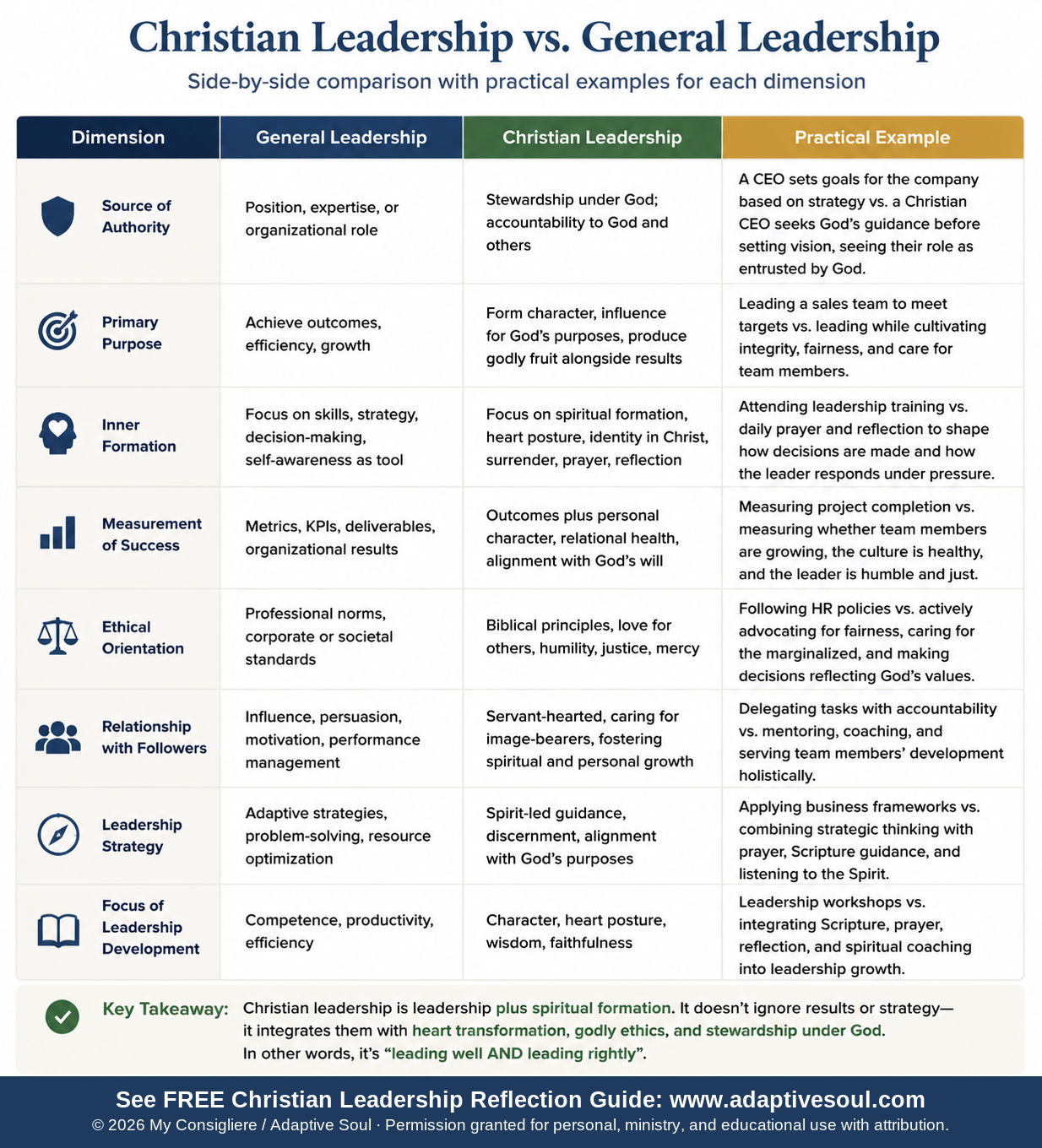
Christian leadership vs. general leadership
The distinction is subtle but significant — mainly the source of authority, purpose, and the role of spiritual formation.
| Dimension | General Leadership | Christian Leadership | Practical Example |
|---|---|---|---|
| Source of Authority | Position, expertise, or organizational role | Stewardship under God; accountability to God and others | A CEO sets goals based on strategy vs. a Christian CEO seeks God's guidance before setting vision, seeing their role as entrusted by God. |
| Primary Purpose | Achieve outcomes, efficiency, growth | Form character, influence for God's purposes, produce godly fruit alongside results | Leading a sales team to meet targets vs. leading while cultivating integrity, fairness, and care for team members. |
| Inner Formation | Focus on skills, strategy, decision-making, self-awareness as tool | Focus on spiritual formation, heart posture, identity in Christ, surrender, prayer, reflection | Attending leadership training vs. daily prayer and reflection to shape how decisions are made and how the leader responds under pressure. |
| How fruitfulness is understood | Metrics, KPIs, deliverables, organizational results | Outcomes held alongside character, relational health, and alignment with God's purposes | Tracking project completion vs. noticing whether team members are growing, the culture is healthy, and the leader is humble and just. |
| Ethical Orientation | Professional norms, corporate or societal standards | Biblical principles, love for others, humility, justice, mercy | Following HR policies vs. actively advocating for fairness, caring for the marginalized, and making decisions reflecting God's values. |
| Relationship with Followers | Influence, persuasion, motivation, performance management | Servant-hearted, caring for image-bearers, fostering spiritual and personal growth | Delegating tasks with accountability vs. mentoring, coaching, and serving team members' development holistically. |
| Leadership Strategy | Adaptive strategies, problem-solving, resource optimization | Spirit-led guidance, discernment, alignment with God's purposes | Applying business frameworks vs. combining strategic thinking with prayer, Scripture guidance, and listening to the Spirit. |
| Focus of Leadership Development | Competence, productivity, efficiency | Character, heart posture, wisdom, faithfulness | Leadership workshops vs. integrating Scripture, prayer, reflection, and spiritual coaching into leadership growth. |
Share or print
Download the visual version
A single-page graphic of the comparison — free for personal, ministry, and educational use with attribution.